
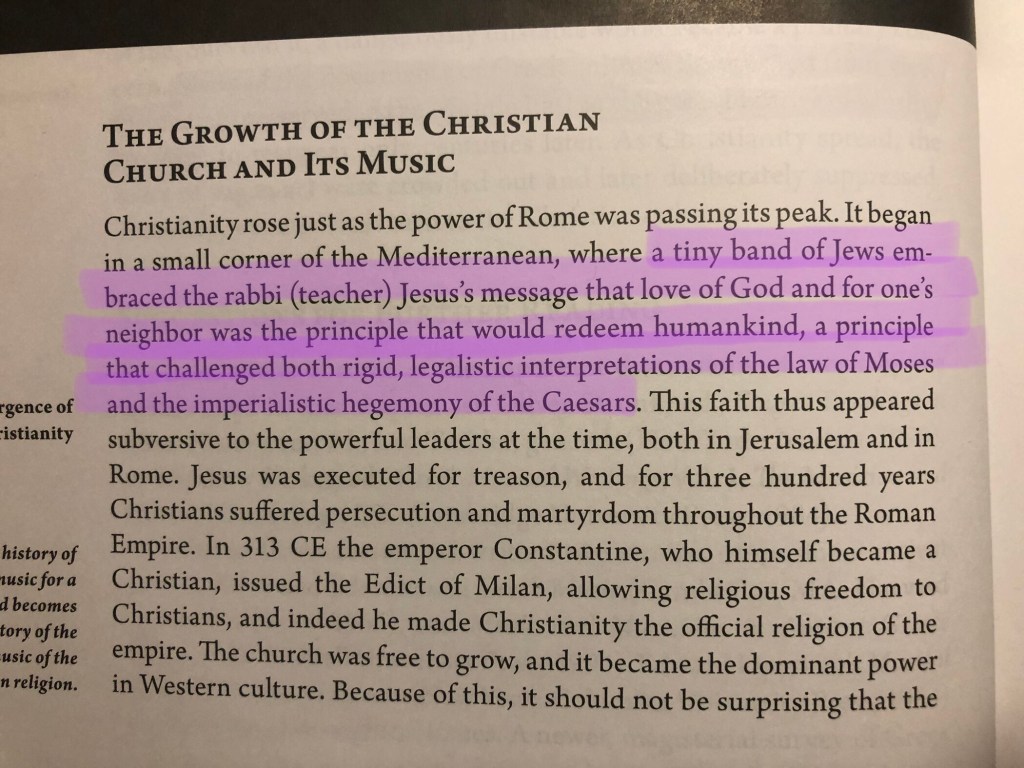
A bit of a personal anecdote:
I found the above pictured excerpt from my History of Western Music class interesting because it was so at odds with the interpretation of Jesus and Christianity as a whole that I was brought up to believe as a child. At the end of the previous chapter, it was also noted that the limited knowledge we have today of ancient Greek culture was largely due to the extensive libraries of Muslim scholars, since the early Christians suppressed it. I was taught in my parochial school, as a child, to believe that paganism and other religions shouldn’t be studied in any capacity, for fear that the Satan will corrupt the spirit. Catholicism was toted as the one true religion, because it was founded by Jesus and his apostles. The modern day Catholic Pope and Bishops are thought to be direct successors of the apostles, beginning with St. Peter. I believe the indoctrination can be stronger when “religion” is a school subject that you’re required to pass, rather than something your parents make you study for an hour or two on Sundays mornings. (They also only taught creationism, and we were told that evolution was only a theory. We were not taught about the distinction between ‘scientific theory’ and ‘theory’ as terms.)
The issue(s):
The widely debated “whitewashing” of history in schools has a lot to do with personal experience. Sometimes people don’t seem to realize that their experience in the US school system might not be the same as those they are talking (or arguing) with. The United States is a large, and largely rural, country, and there are vast cultural differences within the broader culture of the US that the rest of the world perceives. the experience of someone from a small town in New Mexico is not going to be the same as someone from New York City.
Recognizing the validity in another person’s perspective, whether it is based on statistical data or anecdotal evidence (both of which have their own inherent issues; check the links) is key to broadening your own understanding of an event. This is especially important if you weren’t physically there, or even alive yet when an event occurred, or if multiple people have a shared experience.

Critical questions:
Did your school teach American History (the study of the history of North and South America) or US History (the study of our own country?) What state did you grow up in? Does the state lean more liberal or conservative? What about the specific lawmakers in the federal and state department of education?
When you took a State History class, how far back did it go? Was there a single chapter at the beginning of the book about Native Americans, or did it go more in depth? Does your city or town in that state lean more to one direction? Who is in charge of picking textbooks, the district, principal, or individual teacher? Who makes the list of “acceptable” texts to choose from?
Did your classes talk only of the details of peace treaties, or did they discuss the brutal and bloody conquests and battles as well?Who is telling the story? Its most likely the “victors.” Have you ever attended a history class taught by a foreigner? Have you ever studied any history pertaining to the US while abroad?
Did you read excerpts or the entirety of a historical figure’s journal to gain an understanding of their perspective of certain events? Who chose the journal or excerpt and where did they find it? Did you find it while doing research for a paper? What websites or books are you using as research? Is it a peer reviewed article, some website from a google search, or is it Wikipedia? How old is it? Who wrote it and why?
Is the class based off a textbook, or is the text an aid to the teacher? Who wrote the book? What are their qualifications? Who is your teacher, and what are their qualifications?
Some slightly more uncomfortable questions:
What level of education did you receive, and from where? What was the socioeconomic status of your school district, town, the neighborhood the school was in, and your family at the time? Remember that federal and local income taxes directly impact a school’s funding. Do you know if your teachers applied for grants? Did they need to? Did they know/care to know how? If you dropped out of high school, was history a difficult subject for you to pass? If you finished high school but did not attend college, what kind of grades did you receive in history classes? If you attended college, but history wasn’t your major, how difficult were your history classes compared to high school? Did you struggle or succeed easily? Why do you think this was?
In conclusion:
Most people have an angle, and they might not even realize it. If you went to a private school, keep in mind that your teacher isn’t necessarily required to have a degree pertaining to the subject(s) they are teaching. Also keep in mind that ALL teachers and textbook authors are human, and humans are often the product of their environment. They also tend to make mistakes.
My angle is, “ask questions about everything, think critically about the answers, then ask more questions.”
 Curiosity Killed the Cat
Though I went to public schools when America was still number one in the world, back when schools were state ran, and though I went to a university, by watching, pondering, listening, reading, and researching, I discovered the huge amount of distractions and misinformation. It always has been people’s responsibility to educate themselves and question what others teach.
LikeLike